I ran CLM vs Jev on my Mac. Warm System One answers hit 3.7 ms.
Hosted Jev answered my warm System One calls in 92.9 ms p50. Local CLM on Metal did the same payloads in 3.7 ms. That is the headline. Local Kev sat at 210.8 ms.
CLM is Contrastive-LM's System One model: frozen Qwen3-8B encoder, tiny projection heads (~20M), score = scaled cosine, softmax = answer. Upstream assumes Linux + NVIDIA + vLLM. Official install does not support Mac. I packed a portable tree, ported serve-only inference to Metal/MLX, and ran identical TypeSafe /v1/systemone requests against CLM, Kev, and hosted Jev.
What I built
clm-embed-mlx: Qwen3-8B-4bit last-token pooling over/v1/embeddings- Heads on MLX (
device=mlx) loading the same.ptas CUDA - Vector arena cache that keeps state/action projections warm
- Memory preflight so jetsam doesn't eat a half-finished HF fetch next to a fat 35B serve
examples/mac_bench/for apples-to-apples TypeSafe compares
Training stayed torch. This tree is serve + bench + Home Base scaffolding for ghost32.
Mac numbers (2026-09-24)
Sequential serve on Apple Silicon. Same five cases, two repeats. Jev is hosted TypeSafe.
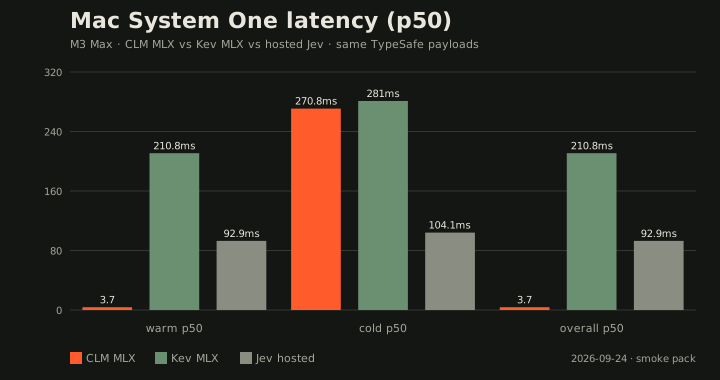
| model | p50 ms | warm p50 | cold p50 | vs Jev argmax | vs Jev TV |
|---|---|---|---|---|---|
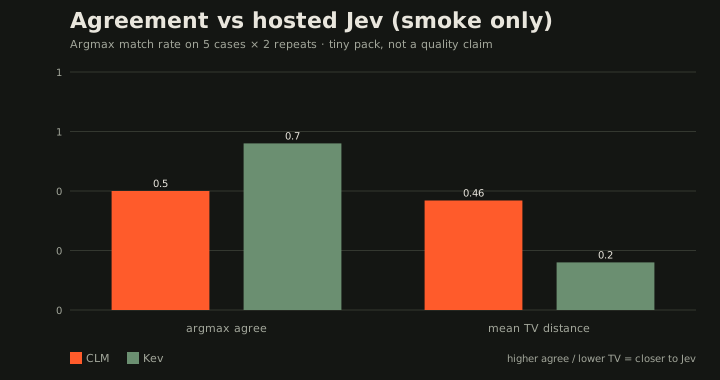
| CLM MLX | 3.7 | 3.7 | 270.8 | 0.50 | 0.46 |
| Kev MLX | 210.8 | 210.8 | 281.0 | 0.70 | 0.20 |
| Jev hosted | 92.9 | 92.9 | 104.1 | — | — |
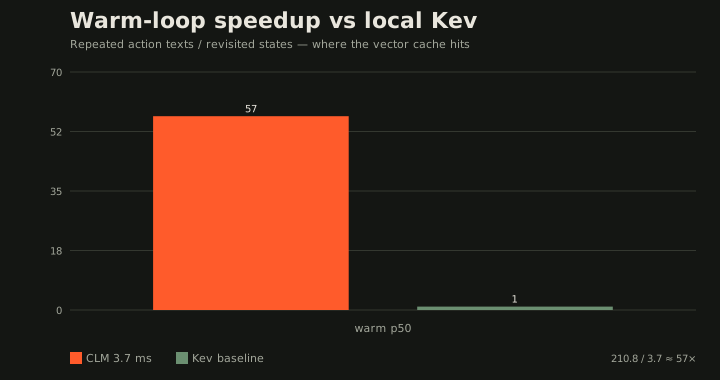
Vs hosted Jev that is ~25× on warm p50. Vs local Kev ~57×. I am chasing warm agent loops: fixed tool sets, revisited rooms, typed routing. Cold texts (new policy excerpt, new tides question) sit near Kev and slower than Jev. Cache miss = encode. Cache hit = cosine.
Upstream zero-shot (their charts, in the tree)
On CUDA they already published the speed story: on par with Jev, up to ~9× lower latency when candidates reuse.
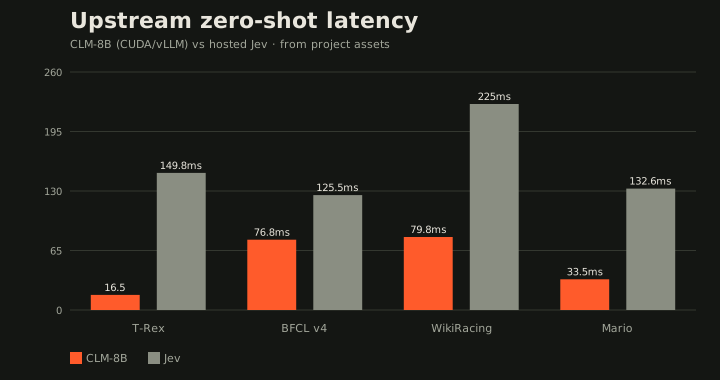
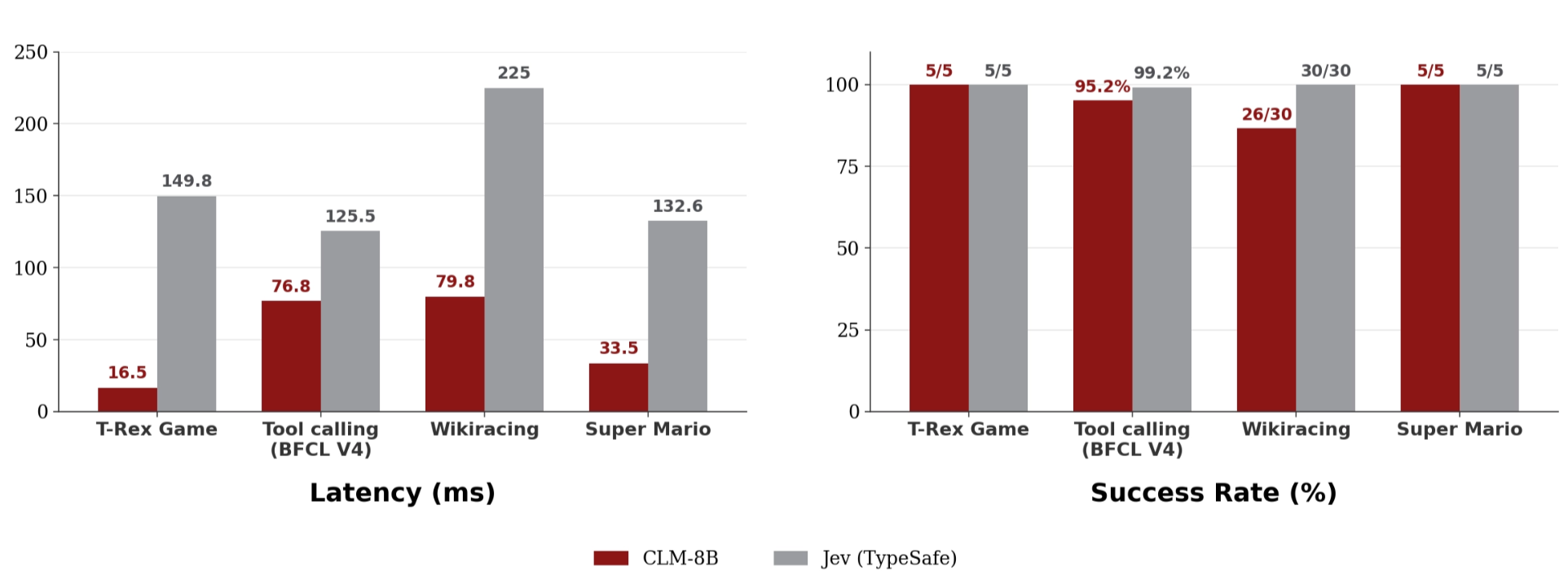
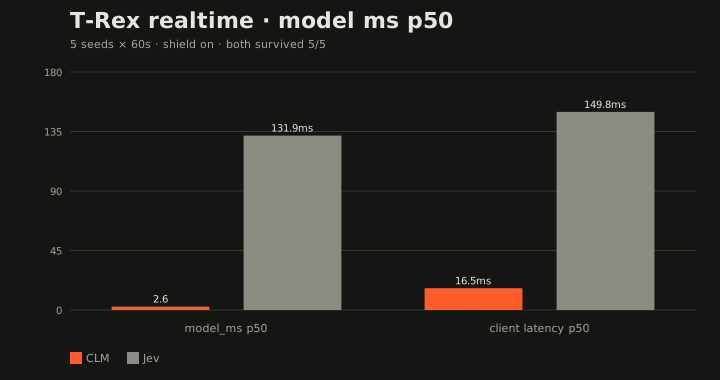
T-Rex in this repo (5 seeds × 60s, shield on): both survived 5/5. CLM model_ms p50 median 2.6 ms vs Jev 131.9 ms. Planner agreement: CLM 0.66, Jev 0.99. Shield interventions are high on CLM. Survival measures the combined system.
Agentic verifier (finetuned heads)
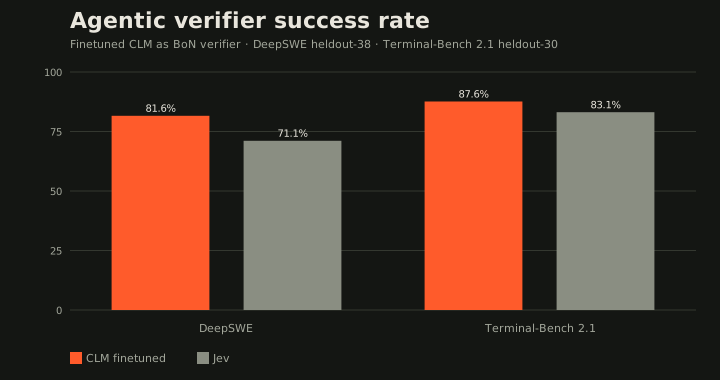
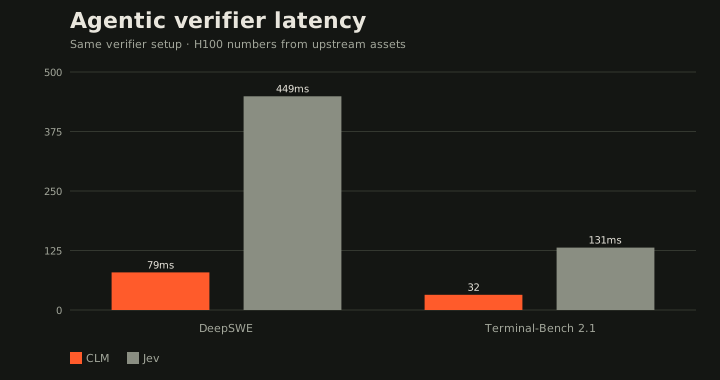
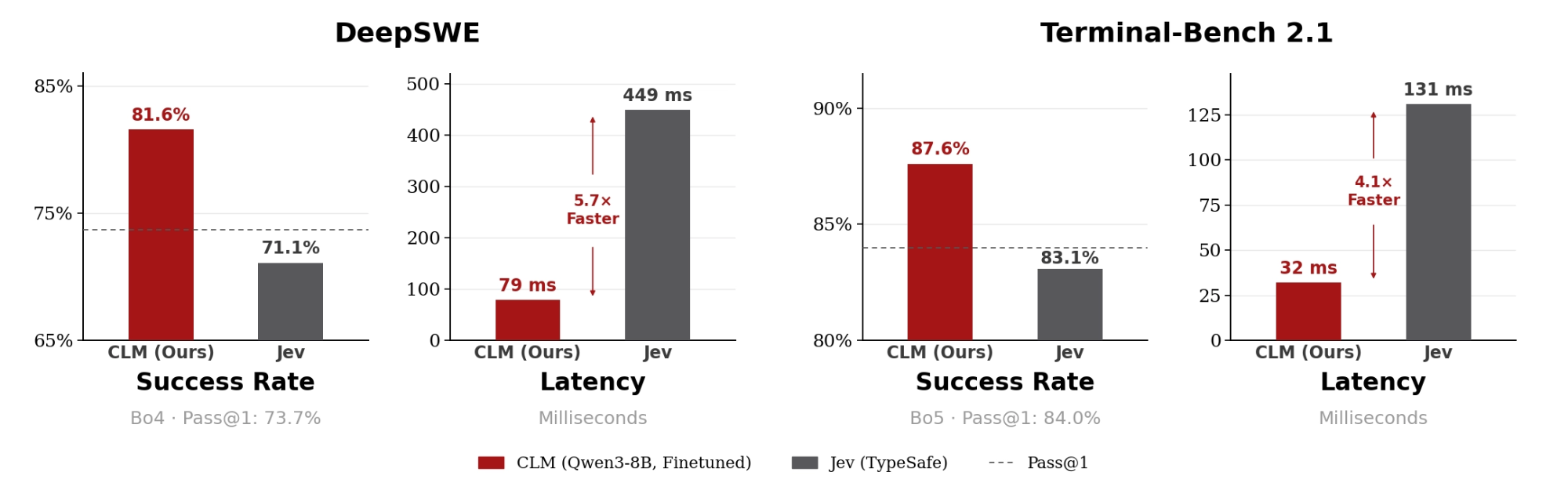
With BoN candidates from Opus/Fable and a fine-tuned head, upstream reports SOTA as verifier:
| bench | CLM | Jev | pass@1 ref |
|---|---|---|---|
| DeepSWE heldout-38 | 81.6% @ 79 ms | 71.1% @ 449 ms | 73.7% |
| Terminal-Bench 2.1 heldout-30 | 87.6% @ 32 ms | 83.1% @ 131 ms | 84.0% |
Memory coexistence
64 GB (and my 128 GB M3 Max) is enough on paper. A fat mlx-serve on Qwen 35B with huge ctx + prefix cache + drafter can leave only a few GiB reclaimable. CLM wants ~8–12 GiB comfortable. I watched jetsam when I stacked 35B ⊕ CLM-8B ⊕ Kev-4B. Bench ran sequential. Lean the chat serve or time-slice.
How I run it
bash scripts/setup_mlx.sh
source .venv/bin/activate
# stop big Metal servers first
bash serve_mlx.sh   # :8090 embeddings + :8700 API
python examples/mac_bench/run.py --models clm,kev,jev
Interactive architecture walkthrough: /blog/clm-mlx-mac/explainer.html
Portable archive: CLM-portable-20260924 on my Desktop. Upstream: Contrastive-LM/CLM.
What I want next
- Encoder parity suite vs CUDA bf16 (4-bit drift is the open question)
- Larger agreement pack before any quality claim
- ghost32 Home Base: CLM on Tailscale so client Macs hold ~0 model RSS
- Lean 35B + CLM coexistence profile
Warm latency is real. Quality vs Jev on Mac is still a homework assignment. I'm publishing the numbers I have.